
☰
04: The Humble Bolt - Bolted Joint Design
Why bolted-joint design is more complicated than it looks
10 September 2026
Nuts and Bolts
The expression “Nuts and Bolts” implies something basic and simple and is generically used to express that idea. In engineering, nuts and bolts do indeed sit at the bottom of the BOM and would certainly be considered the most unglamorous of components. Obviously, they hold everything together so, however humble, they are absolutely critical components.
High Risk Component
Consider the following generic stats from various internet sources. “Broad statistical analyses of mechanical failures in demanding industries (like aerospace) show that fasteners and structural joints consistently account for over 20% of all mechanical system failures.” “In the automotive industry, surveys of service managers reveal that nearly a quarter (23%) of all mechanical problems are caused directly by the loosening or failure of fasteners. Worse still, 12% of brand-new vehicles leave the factory with loose joints.” These statistics, even if somewhat generic, are truly shocking and might cause one to question such ubiquitous usage of threaded fasteners. Yet, there is no obvious alternative which can be as functional, as cost effective and as versatile. And here is the good news – threaded fasteners work and are reliable when they are used properly and manufactured to spec.
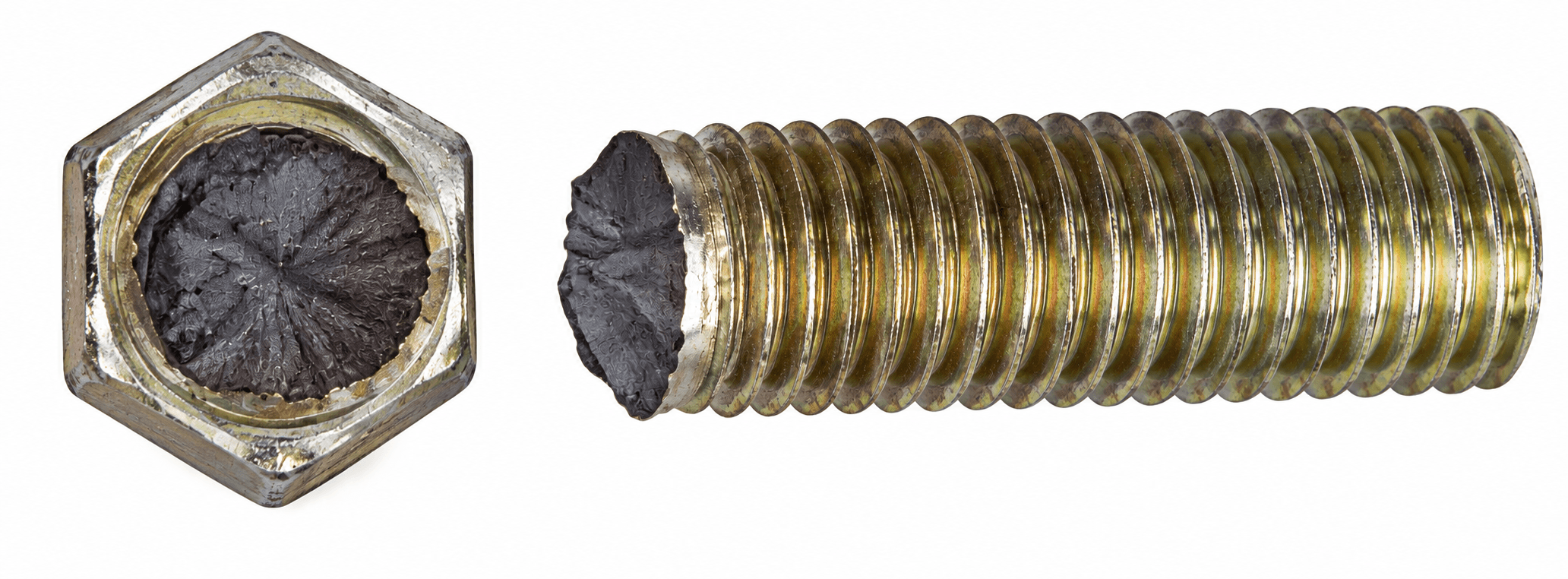
Hydrogen Embrittlement Failure
Failure Modes
Threaded fasteners fail in many ways. Material flaws, corrosion damage, perhaps overloading all spring to mind. However, many failures result from loss of joint preload. This can arise from insufficient initial tightening, settlement or embedment, vibration, or inadequately considered cyclic loading, and can ultimately lead to fatigue failure. Perhaps surprisingly, several internet sources suggest that “perhaps 95% of fastener failures are caused by issues during installation or maintenance (such as incorrect torque or improper preload management), while only 5% are due to a manufacturing defect in the fastener itself.”
The Not So Humble Bolt
VDI2230, the German design standard for bolted joints, consists of 340 pages. A more accessible and easier read is “An Introduction to the Design and Behaviour of Bolted Joints” by John Bickford – it has 951 pages – and that’s just an Introduction!!! This should clarify that designing with threaded fasteners is not straightforward and it is very commonly the case that mechanical engineers are not fully versed in the relevant complexities.
Even in high volume production, bolts are sometimes torqued with the “give it a good squeeze” approach. Very often a design torque is selected off a generic chart. One might casually suggest that there is no need to get into excessive analysis over a threaded joint but consider again the failure percentages indicated above.

Design Issues
A bolted joint effectively consists of a set of compression springs, the washers and clamped elements which are compressed by a tension spring which is the bolt/nut. The joint is conveniently represented using a bolt joint diagram. The bolted joint is typically designed to a preload which ensures joint integrity – ability to carry required load, maintaining a gasket seal, preventing shear, enduring cyclical loading, etc.

ffdfdfd
dfdff
The preload is typically achieved by torquing the nut, and here lies an inherent weakness—torque is only an indirect means of controlling preload and is highly dependent on friction. This introduces unwanted torsional stress in the bolt in addition to the desired tensile stress. Hence, lubrication should typically be used when torquing or, when warranted, the preload achieved by stretching the bolt with a tensile load. Often, a long-life lubricant such as an anti-seize compound or copper grease is required to ensure the joint can be reopened years hence. Lubricant is especially important with stainless hardware where there is the potential for galling.
If the threaded joint loosens, preload is lost and failure is likely – a range of supporting products includes Nyloc nuts, patterned washers, Nord-Lock twin washers, thread locking compounds, etc.. However, a correctly calculated and applied preload is the most critical issue here. And no, double nuts are not always a good idea!
The strength grade of the hardware (eg: 8.8, 10.9, 12.9) needs to be properly selected for the application and the nut and bolt must match accordingly. Picking the highest strength hardware does not ensure the strongest joint! Special attention is necessary when designing a screw joint into a softer material such as aluminium.
Corrosion protections include everything from black oxide, zinc plating, hot-dip galvanise, Greenkote, wax, heavy grease, etc. These require careful consideration allowing for the expected environment. Protective coatings can impact fatigue strength and specific care is required in relation to hydrogen embrittlement, especially with higher strength hardware.
Additional calculations are necessary to address a host of other issues including fatigue, gasketing, flanged joints, prying loads, shear loading, impact loading, etc.
In summary, the design of bolted joints and fastener systems is not straightforward and fraught with danger if not respected. So, to all you mechanical design engineers – let’s be careful out there. There’s rather more to nuts and bolts than nuts and bolts.
04: The Humble Bolt - Bolted Joint Design
Why bolted-joint design is more complicated than it looks
10 September 2026
Nuts and Bolts
The expression “Nuts and Bolts” implies something basic and simple and is generically used to express that idea. In engineering, nuts and bolts do indeed sit at the bottom of the BOM and would certainly be considered the most unglamorous of components. Obviously, they hold everything together so, however humble, they are absolutely critical components.
High Risk Component
Consider the following generic stats from various internet sources. “Broad statistical analyses of mechanical failures in demanding industries (like aerospace) show that fasteners and structural joints consistently account for over 20% of all mechanical system failures.” “In the automotive industry, surveys of service managers reveal that nearly a quarter (23%) of all mechanical problems are caused directly by the loosening or failure of fasteners. Worse still, 12% of brand-new vehicles leave the factory with loose joints.” These statistics, even if somewhat generic, are truly shocking and might cause one to question such ubiquitous usage of threaded fasteners. Yet, there is no obvious alternative which can be as functional, as cost effective and as versatile. And here is the good news – threaded fasteners work and are reliable when they are used properly and manufactured to spec.
Hydrogen Embrittlement Failure
Failure Modes
Threaded fasteners fail in many ways. Material flaws, corrosion damage, perhaps overloading all spring to mind. However, many failures result from loss of joint preload. This can arise from insufficient initial tightening, settlement or embedment, vibration, or inadequately considered cyclic loading, and can ultimately lead to fatigue failure. Perhaps surprisingly, several internet sources suggest that “perhaps 95% of fastener failures are caused by issues during installation or maintenance (such as incorrect torque or improper preload management), while only 5% are due to a manufacturing defect in the fastener itself.”
The Not So Humble Bolt
VDI2230, the German design standard for bolted joints, consists of 340 pages. A more accessible and easier read is “An Introduction to the Design and Behaviour of Bolted Joints” by John Bickford – it has 951 pages – and that’s just an Introduction!!! This should clarify that designing with threaded fasteners is not straightforward and it is very commonly the case that mechanical engineers are not fully versed in the relevant complexities.
Even in high volume production, bolts are sometimes torqued with the “give it a good squeeze” approach. Very often a design torque is selected off a generic chart. One might casually suggest that there is no need to get into excessive analysis over a threaded joint but consider again the failure percentages indicated above.
Design Issues
A bolted joint effectively consists of a set of compression springs, the washers and clamped elements which are compressed by a tension spring which is the bolt/nut. The joint is conveniently represented using a bolt joint diagram. The bolted joint is typically designed to a preload which ensures joint integrity – ability to carry required load, maintaining a gasket seal, preventing shear, enduring cyclical loading, etc.
The preload is typically achieved by torquing the nut, and here lies an inherent weakness—torque is only an indirect means of controlling preload and is highly dependent on friction. This introduces unwanted torsional stress in the bolt in addition to the desired tensile stress. Hence, lubrication should typically be used when torquing or, when warranted, the preload achieved by stretching the bolt with a tensile load. Often, a long-life lubricant such as an anti-seize compound or copper grease is required to ensure the joint can be reopened years hence. Lubricant is especially important with stainless hardware where there is the potential for galling.
If the threaded joint loosens, preload is lost and failure is likely – a range of supporting products includes Nyloc nuts, patterned washers, Nord-Lock twin washers, thread locking compounds, etc.. However, a correctly calculated and applied preload is the most critical issue here. And no, double nuts are not always a good idea!
The strength grade of the hardware (eg: 8.8, 10.9, 12.9) needs to be properly selected for the application and the nut and bolt must match accordingly. Picking the highest strength hardware does not ensure the strongest joint! Special attention is necessary when designing a screw joint into a softer material such as aluminium.
Corrosion protections include everything from black oxide, zinc plating, hot-dip galvanise, Greenkote, wax, heavy grease, etc. These require careful consideration allowing for the expected environment. Protective coatings can impact fatigue strength and specific care is required in relation to hydrogen embrittlement, especially with higher strength hardware.
Additional calculations are necessary to address a host of other issues including fatigue, gasketing, flanged joints, prying loads, shear loading, impact loading, etc.
In summary, the design of bolted joints and fastener systems is not straightforward and fraught with danger if not respected. So, to all you mechanical design engineers – let’s be careful out there. There’s rather more to nuts and bolts than nuts and bolts.
grgrgrgr